📞 :+86-159-9748-3088 📫 :445692254@qq.com
Custom Aluminum Alloy Components for Automotive & Motorcycles: The OEM Manufacturing Guide
Discover why custom aluminum alloy fabrication is essential for high-performance automotive and motorcycle parts. Learn about 6061-T6/7075 billet machining, structural light-weighting, casting vs. forging, and how our factory delivers high-precision OEM/ODM components for global transit industries.
5/14/20266 min read
Custom Aluminum Alloy Components for Automotive & Motorcycles: The Ultimate OEM Manufacturing Guide
The global automotive and motorcycle industries are undergoing a massive transformation driven by one core engineering objective: lightweighting without compromising structural safety. As emissions regulations tighten worldwide and electric vehicles (EVs) require extended battery range, the demand for high-strength, low-weight materials has peaked.
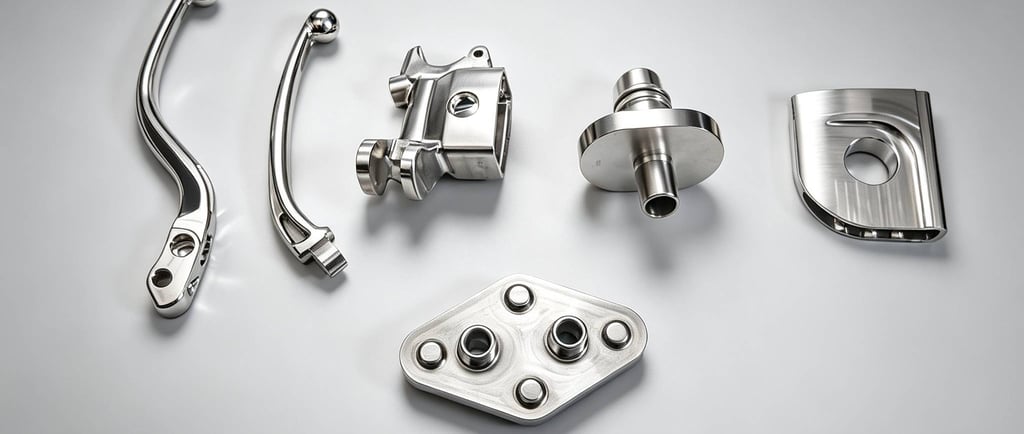
Among these materials, customized aluminum alloys stand out as the premium choice for modern vehicle manufacturing and high-performance aftermarket modification. From complex multi-axis CNC-machined engine brackets and billet triple clamps to lightweight suspension arms and custom structural brackets, tailored aluminum components are vital to modern automotive and motorcycle dynamics.
As an advanced industrial manufacturing factory specializing in custom aluminum alloy fabrication, we have developed this comprehensive guide to help procurement managers, automotive engineers, and motorcycle brands understand the alloys, machining processes, surface finishes, and quality metrics required to create elite-tier vehicle components.
Part 1: Mechanical Advantages of Aluminum in Automotive & Motorcycle Engineering
Why is aluminum increasingly replacing traditional steel and iron in custom automotive and motorcycle production lines? The answer lies in its unique physical and thermodynamic characteristics.
1. Superior Strength-to-Weight Ratio
Aluminum has approximately one-third the density of steel ($2.7 \, \text{g/cm}^3$ compared to $7.8 \, \text{g/cm}^3$). Customizing parts from high-grade aluminum allows engineers to cut vehicle mass dramatically while retaining the tensile strength needed to handle high-stress driving conditions. In motorcycles, this weight reduction lowers the center of gravity and reduces unsprung mass (such as wheels and swingarms), directly improving cornering agility, braking distances, and acceleration profiles.
2. High Thermal Conductivity and Heat Dissipation
Internal combustion engines (ICE), electric vehicle battery enclosures, high-performance braking systems, and racing radiators generate immense localized thermal loads. Aluminum’s thermal conductivity is roughly three times greater than that of steel. This makes custom aluminum alloys ideal for manufacturing engine cylinder heads, oil pans, cooling blocks, and brake calipers—rapidly pulling heat away from critical friction points to prevent thermal degradation.
3. Excellent Energy Absorption (Crashworthiness)
On a weight-for-weight basis, aluminum can absorb twice as much crash energy as mild steel. This makes custom-engineered aluminum extrusions and structural castings perfect for crumple zones, bumper beams, and side-impact subframes. It protects passengers and sensitive EV battery packs by predictable deformation during high-speed impacts.
Part 2: Selecting the Ideal Aluminum Alloys for Custom Vehicle Parts
Different zones of a car or motorcycle require distinct mechanical properties. Our factory utilizes a strict alloy selection matrix to match your blueprints with the perfect material grade.
Aluminum GradeCore CharacteristicsPrimary Automotive ApplicationsPrimary Motorcycle Applications6061-T6Excellent corrosion resistance, highly weldable, superior versatile tensile strength.Engine brackets, suspension manifolds, EV battery frames, intake manifolds.Billet triple trees, footpegs, custom levers, chassis frame plates.7075-T6Ultra-high yield strength (comparable to structural steel), premium fatigue resistance.High-stress racing suspension linkages, steering knuckles, turbocharger impellers.Rear sets, drive sprockets, performance swingarms, wheel hubs.5052-H32Highly formable, excellent sheet metal bending characteristics, elite corrosion resistance.Heat shields, fuel tanks, fluid reservoir tanks, oil coolers, body panels.Custom fenders, license plate brackets, custom fuel tank skins, skid plates.A356 / A380Outstanding casting fluidity, high pressure-tightness, great dimensional stability.Engine blocks, transmission housings, complex structural subframes.Cast wheel rims, crankcase covers, cylinder blocks.
Deep-Dive: The Supremacy of Billet 6061-T6 vs. 7075-T6
6061-T6 (The B2B Manufacturing Standard): This is the go-to grade for 80% of custom machined automotive components. It balances structural strength with excellent machinability and responds beautifully to decorative/protective anodizing. It is ideal for parts exposed to weathering, chemical cleaners, and medium mechanical loads.
7075-T6 (The Ultimate Performance Alloy): Often called "aircraft-grade aluminum," its primary alloying element is zinc. When a motorcycle brand requires an ultra-thin, aggressively skeletonized part—like a professional racing sprocket or a high-torque steering linkage—7075-T6 is specified. It withstands severe cyclical mechanical stress without stress cracking.
Part 3: Advanced Manufacturing Processes in Our Custom Factory
To transform raw aluminum blocks or sheet coils into precision vehicle components, our factory utilizes high-tier, multi-layered production technologies.
1. Multi-Axis Precision CNC Machining (Billet Parts)
"Billet" components are machined entirely from a single solid block of extruded aluminum alloy using high-speed CNC milling and turning centers.
5-Axis CNC Machining: For complex organic shapes, such as aerodynamic motorcycle engine covers or high-clearance wheel hubs, our continuous 5-axis machines eliminate the need for multiple fixture setups. This guarantees sub-micron concentricity and holds tight dimensional tolerances down to $\pm0.01 \, \text{mm}$, ensuring a perfect drop-in fit onto the vehicle assembly line.
2. High-Pressure Die Casting & Gravity Casting
When production volumes scale from hundreds to tens of thousands of units, billet machining becomes less cost-effective. For high-volume automotive OEM parts—such as transmission cases, alternator housings, and water pumps—we utilize high-pressure die casting (HPDC) and gravity casting with A356 or A380 alloys. This allows the rapid replication of complex thin-walled internal chambers with excellent surface finishes and minimal secondary machining requirements.
3. Custom Sheet Metal Fabrication & Welding
For body shielding, floor pans, and fluid management systems, our facility deploys CNC laser cutters, precise CNC press brakes, and automated robotic TIG/MIG welding. Welded 5052 or 6061 aluminum fuel tanks and radiator cores are pressure-tested to guarantee zero leakage under intense operational vibrations.
Part 4: Critical Surface Treatments for Severe Road Exposure
Automotive and motorcycle parts operate in harsh environments. They are constantly pelted by road debris, exposed to salt water, splashed with corrosive engine fluids (brake fluid, oil, gasoline), and subjected to extreme UV radiation. Raw aluminum will oxidize and degrade over time if left untreated. Our factory provides specialized industrial finishes to maximize part longevity:
1. Type II and Type III Anodizing (Corrosion & Wear Resistance)
Anodizing transforms the aluminum surface into an ultra-hard aluminum oxide layer integrated directly with the base metal.
Type II (Decorative Anodizing): Widely used for motorcycle accessories like handlebar risers, levers, and engine caps. It protects the metal while allowing brilliant, fade-resistant color dyes (such as deep black, red, blue, or gold) to enhance the vehicle's aesthetic appeal.
Type III (Hardcoat Anodizing): This process creates a dense ceramic barrier up to 50 microns thick. Hardcoat anodizing is specified for high-wear components like suspension shock tubes, internal engine pistons, and heavy-duty automotive gears, offering rock-solid scratch and abrasion resistance.
2. Powder Coating (Heavy-Duty Shielding)
For structural parts like subframes, suspension arms, and wheels, powder coating provides a thick, flexible polymer layer that resists stone impacts and aggressive road salt corrosion better than liquid paint.
3. Precision Shot Peening & Media Blasting
To increase the fatigue life of high-stress performance parts (like racing connecting rods or suspension springs), we perform shot peening. This process introduces compressive residual stress on the part's surface, preventing micro-fissures from propagating under high mechanical loads.
Part 5: Strict B2B Quality Control and Global Traceability
In the automotive sector, component failure can lead to vehicle recalls, liability issues, and driver injury. Our factory implements a multi-stage Quality Management System (QMS) to secure every production batch.
1. Material Verification via MTRs
We do not use unverified recycled scrap or secondary market metal ingots. Every raw aluminum bar, plate, or ingot that enters our facility comes with an official Material Test Report (MTR). This document certifies the precise chemical composition and mechanical properties of the batch, ensuring it complies with international ASTM or SAE standards.
2. Advanced CMM Metrology and Non-Destructive Testing (NDT)
Coordinate Measuring Machines (CMM): After machining, automated 3D CMM probes verify critical dimensional layouts against the client's original STEP or IGES CAD files.
X-Ray Defect Detection: For cast structural parts (like custom wheel rims), we utilize non-destructive X-ray testing to inspect for internal porosity or micro-voids, ensuring the casting can handle heavy high-speed loads.
3. ISO 9001 and IATF 16949 Alignment
Our manufacturing facility aligns its production standards with ISO 9001 and IATF 16949 (the global standard for automotive quality management systems), guaranteeing continuous improvement, rigid process control, and full supply-chain traceability.
Part 6: Partnering with Our Factory for Custom Aluminum Solutions
Choosing the right custom fabrication partner is critical to keeping your automotive assembly line running smoothly. Our factory provides an end-to-end B2B manufacturing experience:
Design for Manufacturing (DFM) Reviews: Before cutting metal, our engineering team reviews your CAD files to optimize tool pathways, eliminate unnecessary thin-wall complexities, and suggest the most cost-effective manufacturing method (e.g., converting a high-volume part from CNC machining to precision casting).
Rapid Prototyping to Mass Production: We support your entire product lifecycle. We can manufacture a single low-volume prototype for track testing and scale seamlessly to mass production runs of over 50,000 pieces.
Efficient B2B Logistics: We work with top-tier international freight forwarders to provide fully insured, expedited ocean or air shipping, managing customs documents to deliver parts directly to your assembly plant or distribution warehouse.
Conclusion: Upgrade Your Automotive Supply Chain Today
Custom aluminum alloy fabrication is the key to unlocking lighter, faster, and more efficient vehicles for the automotive and motorcycle industries. By matching advanced multi-axis CNC machining, high-pressure die casting, and resilient hardcoat anodizing with rigid quality control, our factory delivers elite-tier components that meet strict OEM criteria.
Are you looking to optimize your automotive or motorcycle component supply chain? Partner with an experienced industrial aluminum factory today.
Our Core Capabilities: Multi-axis Billet CNC Machining, High-Pressure Aluminum Casting, Precision Sheet Metal Welding, Type III Hardcoat Anodizing.
Get a Fast Technical Quote: Upload your 3D CAD blueprints (STEP, IGES, or DWG formats) directly to our engineering sales portal. Our engineers will provide a comprehensive DFM evaluation and a competitive contract proposal within 24 hours!
Contact our global engineering sales division through our online portal, and let us turn your high-performance vehicle blueprints into a high-precision manufacturing reality!